The artists of The Indus Sings and the music that crosses traditions without erasing them
“Where there is music and love, the heart finds its home.” — Rumi
The musical conversation that will unfold on May 10th is the product of years of practice, lineage, and a shared understanding that the deepest form of artistic dialogue is not fusion. It is listening. Real listening, the kind that requires you to hold your own tradition with enough confidence that you can genuinely hear someone else’s.
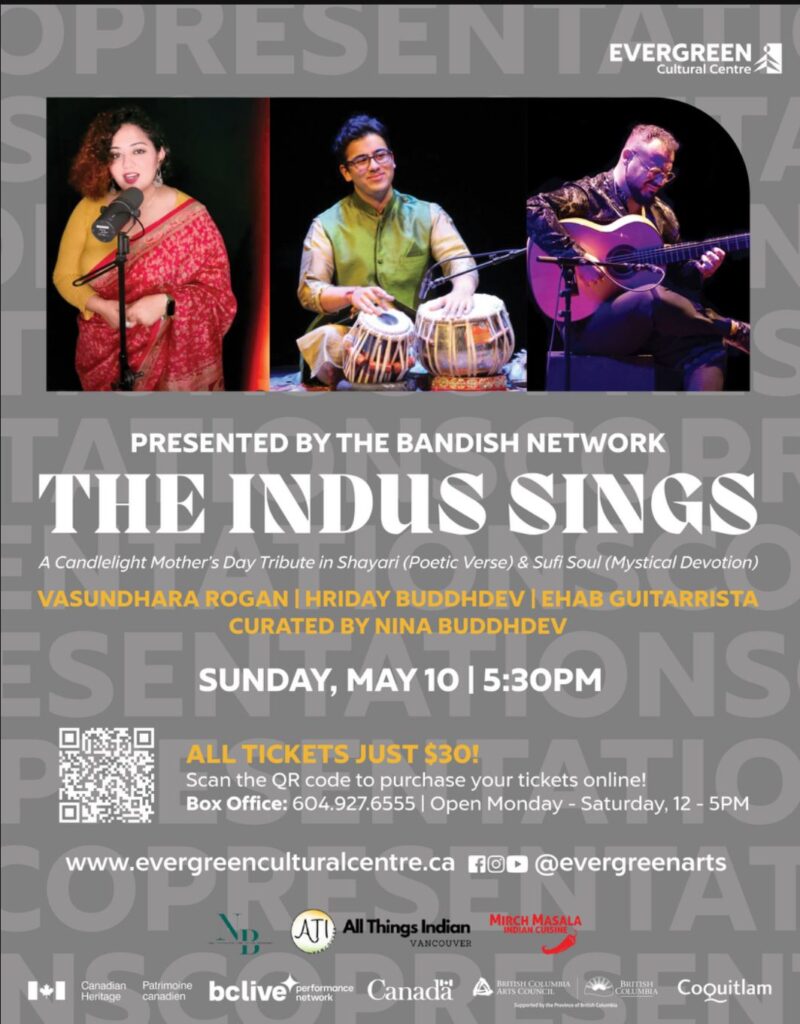
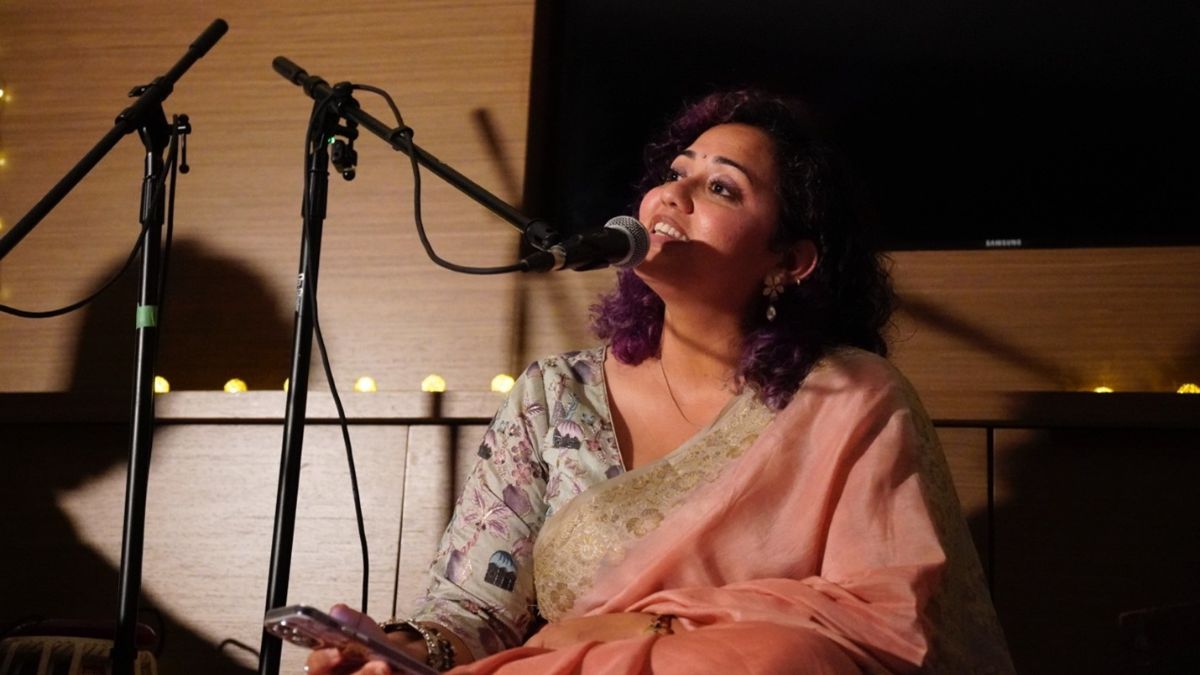
The evening is anchored by Vasundhara RoGan, whose voice moves across languages and emotional registers with an ease that only comes from genuine immersion. Her repertoire draws from Shayari, Ghazal, and the devotional currents of Sufi tradition, weaving Hindi, Urdu, Farsi, and Arabic into a seamless whole. She does not perform poetry so much as inhabit it, rendering the formal structures of classical verse as though they were breathing organisms rather than inherited forms.
Shayari is among the most demanding of poetic traditions: compressed, allusive, layered with meaning that accumulates across centuries of use. A single couplet can carry the weight of a theological argument, a love poem, and a political critique simultaneously. To sing it well requires not only vocal technique but philosophical fluency. Vasundhara RoGan brings both.
THE HEARTBEAT AND THE CONVERSATION
Accompanying her, Hriday Buddhdev’s tabla provides both the foundation and the propulsion of the evening. The tabla, in skilled hands, is among music’s most expressive instruments. It is capable of extraordinary delicacy and quietly devastating precision. It can mark time with the regularity of a metronome and dissolve that regularity in the same breath, opening space for the melodic line to expand and breathe.
Hriday’s work on the tabla is not merely accompaniment. It is a conversation conducted in rhythm, responding to the contours of the poetry, shaping the emotional arc of each piece, and providing the structural architecture within which the evening’s more expansive moments become possible.
Into this conversation enters Ehab Guitarrista, whose Spanish guitar expands the tonal landscape in ways that are genuinely surprising and genuinely earned. The guitar enters the music not as a guest or a novelty but as a full participant, bringing the warmth and complex overtone structure of the classical Spanish tradition into dialogue with the melodic sophistication of Hindustani and Sufi forms.
In Indian philosophy there is an ancient understanding of sound itself that the evening honours:
नाद ब्रह्म
Nada Brahma. The universe is sound.
And a classical Sanskrit teaching that reminds us of music’s deepest purpose:
नादोपासनया देवाः ब्रह्मविष्णुमहेश्वराः
Through devotion to sound, the divine itself is realized.
IMMERSIVE CONVERSATION
It would be easy and inaccurate to call what these three artists do fusion. Fusion implies a blending in which origins become indistinguishable. What happens here is something more respectful and more musically interesting: a conversation in which each tradition retains its integrity while listening deeply to the others.
The Spanish guitar does not become Hindustani. The tabla does not become flamenco. The poetry does not lose its Persian and Urdu roots. But all three find, in each other, something they could not have found alone: a resonance that opens onto questions that no single tradition has fully answered. What is the relationship between form and devotion? Between discipline and surrender? Between the structured and the boundless?
“This is not fusion in the casual sense. It is a conversation. Each tradition retains its integrity while listening deeply to the others.”
Under candlelight, the effect of this conversation becomes immersive in a way that performance in brightly lit venues rarely achieves. Time slows. Attention sharpens. The audience is invited into a shared field of listening where each note carries, simultaneously, the weight of its history and the lightness of its presence in this specific room, on this specific evening, in this city at the edge of a continent far from the Indus and yet, tonight, not so far at all.
The evening opens with the MAA Chai pre-concert tea reception, which sets the tone precisely: warmth, proximity, the textures of shared food and conversation, before the music begins. Vasundhara RoGan presents an enchanting evening of poetry and music, blending Shayari with Sufi Soul in Farsi, Urdu, and Hindi, alongside prose. Tickets are thirty dollars and include the reception.
Next week: The final article in the series. An Evening That Lingers. A love letter to mothers, to music, and to the quiet certainty that culture held with care will always find its way forward.
SERIES: THE INDUS SINGS · WEEK FIVE OF SIX